
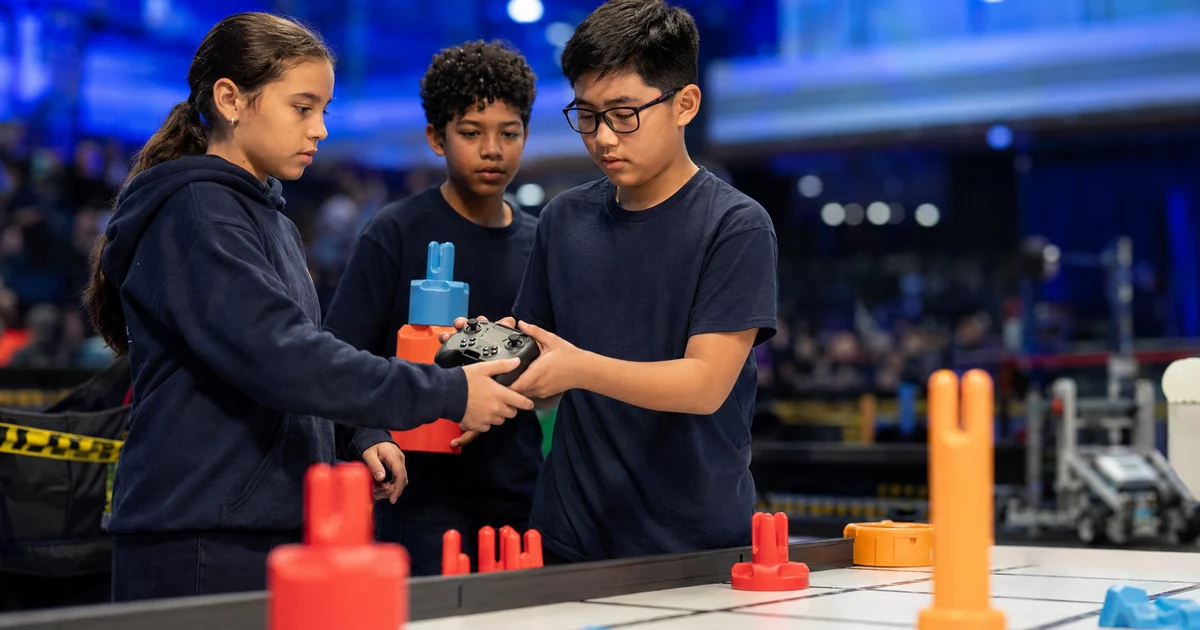
“Who’s driving today?”
It sounds like a simple question. On most rookie teams, the answer is whoever wants the controller most — or whoever the coach defaults to. On teams that win consistently, driver selection is a deliberate decision, not a habit.
Here’s the thing: VEX IQ has two completely different driving disciplines — Teamwork and Skills — and the best driver for one is often the wrong driver for the other. Add in that different match strategies make different demands on the kid behind the controller, and “who drives?” turns into a real planning problem.
Three frameworks help.
Framework 1: One Driver Per Discipline
The cleanest split is by match type.
- Teamwork driver — drives Teamwork Challenge matches. The field is chaotic, your alliance partner is doing things you didn’t plan for, and the situation changes second by second. This driver needs to read the field fast, communicate with the alliance, and adapt.
- Skills driver — drives Driver Skills matches. One robot, one minute, no alliance partner. The field is identical every run. This driver needs to execute the same route the same way, every single time.
These are different jobs. A great Teamwork driver who hates repetition might be mediocre at Skills. A precise Skills driver who freezes when the field doesn’t match the practice setup will struggle in Teamwork.
Splitting the roles isn’t a demotion for either kid — it’s specialization. Each driver gets twice the practice time on their specific challenge.
Framework 2: One Driver Per Strategy
A more advanced version: split drivers by strategy, not just by match type. Strategy isn’t one thing — and the demands on the driver shift with it.
In Skills, most seasons have multiple viable routes. A low-risk consistency route — slow, predictable, scores a known floor. Or a high-ceiling aggressive route — faster, more scoring potential, but more failure modes.
- Consistency rewards calm execution and muscle memory. The kid who can do the same boring run 50 times in practice is the kid who’ll do it correctly on run 51.
- Aggressive rewards reaction speed and willingness to recover from mistakes mid-run. The kid who can salvage a missed pickup and still finish strong is who you want here.
In Teamwork, strategy depends on the alliance partner. Pairings change match to match, and your game plan with a strong partner looks nothing like your plan with a weak one.
- Strong partner — you can specialize. Divide the field, both go for high-value tasks, trust them to handle their side. This needs a driver who coordinates quickly, communicates before the match, and sticks to a clean division of labor without drifting onto the partner’s targets.
- Weak partner — you have to carry. Take on what they can’t, drive conservatively to avoid colliding with their attempts, and improvise when their plan doesn’t materialize. This needs a wide tactical repertoire and the patience to recover from a partner’s failed attempt without losing the match.
These aren’t always the same kid. A driver who shines with a strong partner — fast division of labor, surgical specialization — may freeze when handed a weak one who keeps bumping into them. A “carry” driver who handles weak partners well may overplay and crowd a strong partner who didn’t need help.
When you assign drivers by strategy, you can train each kid specifically for their scenarios. Practice stops being generic “let’s run the field” and becomes targeted: this kid drills the consistency Skills route 30 times today; that kid scrimmages against the weakest partner you can simulate; another scrimmages with the strongest.
This is how good teams turn 90 minutes of practice into real improvement, not just time on the controller.
Framework 3: The Coder-as-First-Driver Pattern
Here’s a pattern that shows up on strong teams again and again: the kid who writes the autonomous code is often the best Skills driver — and specifically the first driver in a sequence.
Why?
Coders think in sequences. They’ve spent hours writing instructions that execute step by step, in order, exactly as planned. That mental model — “follow the plan, trust the plan, don’t improvise” — is exactly what Skills driving demands. One minute, one route, fifty practice runs, identical every time.
What coders often aren’t great at is reading a chaotic Teamwork field and inventing a new plan on the fly. Their strength is execution, not improvisation. Drop them into a Teamwork match where the alliance partner just blocked the goal they planned for, and they tend to pause, processing — which costs seconds you don’t have.
So a common arrangement on competitive teams looks like this:
| Role | Best Fit |
|---|---|
| Skills driver / first driver | Coder, sequential thinker, comfortable with repetition |
| Teamwork driver / closer | Adaptive thinker, fast field reader, comfortable improvising |
In a two-driver Skills handoff, “first driver” gets the predictable opening of the route. The closer takes whatever state the first driver leaves and finishes the run. The coder’s plan-following strength is wasted on cleanup but perfect for the opening.
How to Actually Do This on Your Team
You don’t need to lock in roles forever. Start with experiments.
- Run a Skills time trial with each kid. Same route, three runs each. Look at consistency, not just top score. The kid whose three runs are within 2 points of each other is your Skills candidate.
- Run a Teamwork scrimmage with mixed alliances. Watch who communicates, who reads the field, who recovers from a teammate’s mistake without freezing.
- Ask the coder to try the Skills route. Most of the time you’ll find they execute it cleaner than the kid who’s been driving it casually for weeks.
- Once roles are clear, train specifically. Skills driver gets Skills practice. Teamwork driver gets scrimmages against varied partners. Don’t waste a Skills driver’s slot on Teamwork drills “for variety.”
The biggest mistake teams make is “sharing driving fairly.” Equal practice time isn’t the same as equal role assignment. A team where every kid drives a third of every match is a team where no one is excellent at any one thing.
Not Every Kid Needs to Drive
Driving isn’t the only role that wins matches. The most valuable kid on a strong team often rarely touches the controller.
- Engineering Notebook lead — judged awards (Excellence, Design) hinge on it. A team that wins their division but has a sloppy notebook stalls at qualification.
- Project / Innovate lead — for Innovate and STEM Research awards, this kid is the team. Their presentation and interview answers decide what the judges remember.
- Pit / competition manager — tracks the schedule, manages spare parts, coordinates scouting, decides who’s driving the next match. Without them, match day runs on chaos.
- Builder — the kid who can diagnose a wobble between matches, swap an axle in 90 seconds, or redesign a failing intake on Saturday morning is more important than a third driver.
And then there’s the role almost every team underestimates: the loader.
The Loader Is a Strategist, Not a Helper
The loader feeds game elements into the field during a match. On the surface, it looks like the least skilled job — hand the element over, walk to position, repeat.
But the loader is the only person on the team with time to watch the whole match unfold. The driver’s eyes are locked on the robot. The coach can’t communicate mid-match. The loader can see what’s working, what isn’t, where the alliance partner is heading, and how much time is left.
A good loader:
- Paces the supply — feeds the right element at the right moment, not just whatever’s next.
- Reads the field — notices an opportunity the driver missed and signals it within the rules (eye contact, position, ready stance).
- Stays calm — when the driver makes a mistake, a flustered loader makes it worse; a composed loader resets the rhythm.
Some teams put their sharpest field-reader in the loader role on purpose. Instead of fighting for controller time, that kid steers the team’s score by feeding the right element at the right beat. A great loader can lift a team’s match-day average more than a marginal improvement in driving — and is often the easier path to consistent results than trying to make a fourth driver “good enough.”
If a kid says “I want to drive” and isn’t a natural at it, don’t push them to drive worse. Ask them: would you rather drive okay, or be the loader who actually decides whether we win?
What This Means for Parents
If your child was “only” assigned to drive Skills — or only Teamwork, or only the opening half of a route — that’s not a demotion. It’s specialization. The kids on winning teams aren’t generalists who do a bit of everything. They’re specialists who own their slice of the match.
And if your child isn’t driving at all — if they’re the builder, the notebook lead, the pit manager, or the loader — that’s not a consolation prize either. Those roles often shape a team’s results more than the controller does.
Ask the coach: what is my kid’s role, and what does great look like in that role? Then support practice toward that specific definition of great.
What This Means for Students
If you’re the coder, lean into Skills driving. Your brain is already wired for it. The kid who can drive a clean repeatable route is more valuable to the team than the kid who can do an okay job of everything.
If you’re the improviser who hates running the same route twice — own Teamwork. The chaos is your edge.
And if your gift is reading the field rather than reacting fast — own the loader role. It’s the most underrated seat on the team.
The team wins when each kid is doing the job their brain is best at.
The question isn’t “who’s the best driver?” The question is “who’s the best driver for this match, this strategy, this moment?”


